







Tooth decay doesn’t start as a painful hole in your tooth; it begins as a microscopic battle on your enamel that often goes unnoticed. Many people in our community only search for dentists Port Macquarie NSW once they start feeling a persistent ache. However, waiting for pain can be a costly mistake.
The biggest challenge is that by the time you feel a “zing” or a throb, the window for white spots on teeth treatment and natural recovery has usually already closed. Understanding the tooth decay stages is the best way to protect your smile and your wallet. Catching these signs early at Hastings Dental Centre means we can often reverse cavities Port Macquarie using simple methods, helping you avoid the dental drill and the need for emergency dental NSW visits later on.
5 Stages of Tooth Decay
Stage 1: Initial Demineralisation (The Golden Window)
This is the very beginning of a cavity. At this stage, you might notice small, chalky white spots on your teeth, often right near the gumline. You won’t feel any pain yet, which is why it is so easy to ignore.
The Science The white spots mean that acids from food and bacteria have started leaching essential minerals out of your enamel. Your tooth is losing its strength, but the structure hasn’t collapsed yet.
Is it Reversible? Yes. This is the only stage where you can actually heal the tooth without needing a filling.
The Fix Because the surface is still intact, we can use professional fluoride treatments to put those minerals back into the enamel.
Port Macquarie Tip: We are lucky in Port Macquarie because our local tap water contains fluoride, which acts like a constant repair kit for your teeth. Drinking plenty of tap water and using a fluoride toothpaste are your best defences. If you notice these white spots, come in for a quick check so we can help you strengthen your enamel before a physical hole forms.
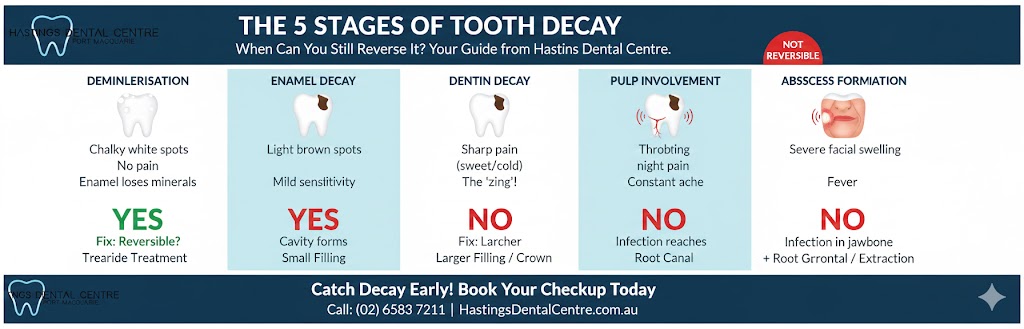
Stage 2: Enamel Decay (The Point of No Return)
As decay progresses, those initial white spots start to change. They often turn a light brown colour, and you might notice a slight sensitivity when you eat something very cold or sweet.
The Science At this point, the enamel has officially broken. A small, physical hole called a cavity has formed in the hard outer layer of your tooth. While the damage is still small, the protective barrier is no longer solid.
Is it Reversible? No. Unlike the first stage, enamel cannot grow back or heal itself once a physical hole exists.
The Fix The good news is that the solution is usually simple. A small, tooth-coloured filling can seal the hole, stop the decay from spreading deeper, and restore the strength of your tooth.
Stage 3: Dentin Decay (The “Zing” Stage)
This is the stage where most people finally realise something is wrong. You might feel a sharp “zing” or a sudden jolt of pain when drinking a hot coffee, having a cold juice, or eating sugary snacks.
The Science The decay has now eaten through the enamel and reached the softer layer underneath called dentin. Dentin is much more porous than enamel and contains tiny tubes that lead directly to the tooth’s nerve. Because it is softer, the decay now spreads twice as fast as it did before.
The Fix Since the cavity is now larger and deeper, a bigger filling is usually required. If the decay has weakened a large part of the tooth, we might suggest a dental crown to protect the remaining structure and prevent the tooth from cracking.
Stage 4: Pulp Involvement (The Midnight Throbbing)
If you find yourself awake at 2 AM with a persistent, throbbing pain, you have likely reached this stage. Unlike the quick “zing” of earlier stages, this pain is constant and often feels much worse when you lie down. This is a common reason patients reach out to dentists Port Macquarie NSW for urgent care.
The Science The decay has now travelled through the enamel and dentin to reach the “pulp.” This is the living centre of your tooth that contains all the sensitive nerves and blood vessels. When bacteria enter this space, it causes significant inflammation and pressure, which is why the pain is so intense.
The Fix At this point, a standard filling is no longer enough. To save your natural tooth, Root Canal Therapy is usually the necessary path. We remove the infected tissue, clean the canals, and seal the tooth. It is a last-ditch effort to keep your tooth in place rather than losing it entirely.
Stage 5: Abscess Formation (The Emergency)
This is the final and most serious stage of tooth decay. You may notice severe pain that radiates to your jaw or ear, visible facial swelling, a fever, or even a small “pimple” or bump on your gums near the sore tooth.
The Science The infection has now pushed past the tooth and travelled through the root into the surrounding jawbone. This creates a pocket of infection known as an abscess. Because the infection is no longer contained inside the tooth, it can start to affect your overall health.
The Fix This is a dental emergency. Treatment involves emergency drainage of the infection and a course of antibiotics to stop the spread. From there, we will need to determine if the tooth can still be saved with a root canal or if a total extraction is the safest option for your health.
How to Stay in the "Reversible" Zone?
The goal for your dental health is to stay in the first stage of decay for as long as possible or avoid it entirely. While your teeth are constantly under attack from acids, you have the tools to fight back and keep your enamel strong. By following a few simple steps, you can help your teeth win the battle and stay in that golden “reversible” zone.
Actionable Advice for a Healthy Smile
Brush twice daily with fluoride toothpaste: Fluoride is a natural mineral that acts as a repair kit for your teeth. It helps with a process called remineralisation, which puts essential minerals back into your enamel and can even help with white spots on teeth treatment.
Floss to catch “hidden” decay: A toothbrush cannot reach the tight spaces between your teeth. Daily flossing is the only way to remove the plaque and food particles that cause decay in these hidden areas.
The 6-Month Rule: Regular checkups at Hastings Dental Centre are vital. Dentists Port Macquarie NSW have the tools to spot the very first signs of tooth decay stages before you ever feel a “zing.” Catching decay at Stage 1 means you can often reverse cavities Port Macquarie without ever needing a filling.
Take Control of Your Smile Today Notice a white spot or a strange “zing” when you drink something cold? Don’t wait for the pain to get worse. Book your assessment at Hastings Dental Centre today before a small fix becomes a big problem. Whether you need a routine checkup or emergency dental NSW care, our friendly team is here to help you maintain a healthy, pain-free smile.
 Prefer to talk first? Call our friendly team at (02) 6583 7211 for clear guidance and to book your next step.