




Missing a tooth changes more than your smile. It can affect how you chew, how your speech sounds, and how confident you feel in everyday conversations. If you’ve been putting off doing something about it, you’re not alone — but the good news is that modern dental implants offer a well-established way to restore both function and appearance.
At Hastings Dental Centre, we get a lot of the same questions from Port Macquarie locals weighing up their options. This guide walks through the process, what influences cost, and what’s worth asking before you commit to treatment.
Who Are Dental Implants For?
Implants aren’t the only way to replace a missing tooth — options like crowns and bridges may suit some situations better, depending on your bone health, gum condition and budget. Broadly speaking, implants tend to come up in conversation for:
- A single missing tooth, where you don’t want to affect the teeth either side of the gap
- Several missing teeth in a row, where an implant-supported bridge can spread the load
- A full arch of missing or failing teeth, where a fixed full-arch restoration is being considered
If you’re dealing with cracked or missing teeth from an old injury or years of wear, it’s worth having a proper look at your jawbone and gum health first — this is what determines whether implants are a suitable option for you, not the other way around.
The Implant Process, Step by Step
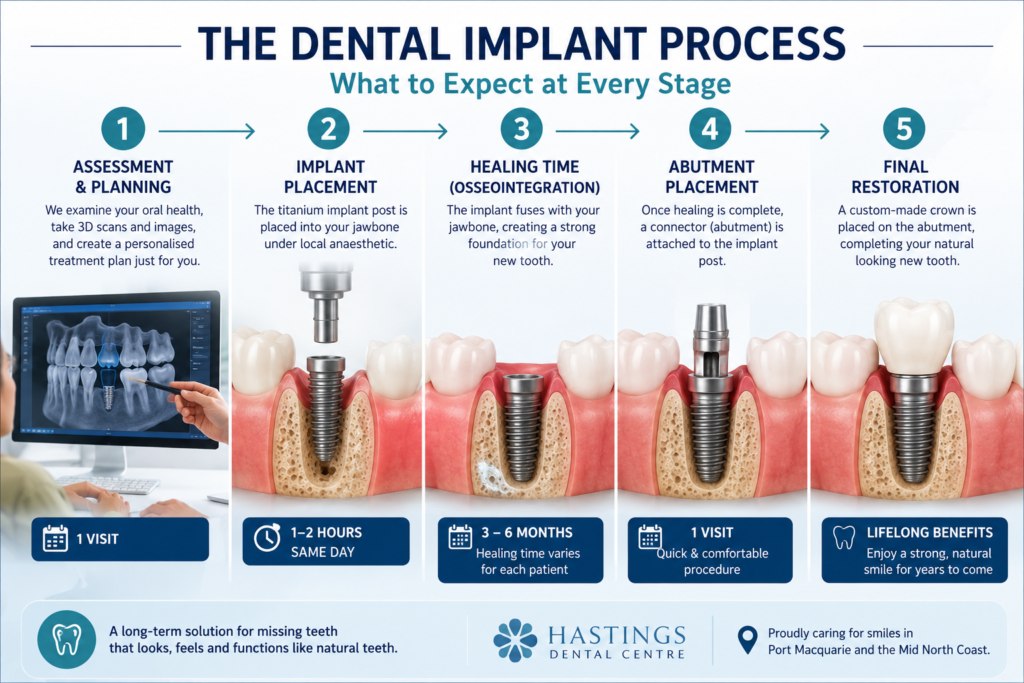
Every case is different, but the general pathway looks like this:
1. Assessment and planning. A clinical examination, plus 3D imaging where needed, to understand your bone density, gum health and overall suitability. This is also when a treatment plan and cost estimate is put together for you.
2. Placement. The implant post — a small titanium fixture — is placed under local anaesthetic. Most patients describe the day itself as far more manageable than they expected, though everyone’s experience differs.
3. Healing time. This is the part that catches people off guard: the bone needs time to fuse around the implant post, which typically takes a few months. Your dentist will monitor progress along the way.
4. The final restoration. Once healing is confirmed, a custom-made crown is fitted to complete the tooth, matched to the shape and shade of your natural teeth.
It’s a process that rewards patience — rushing any one of these stages isn’t in your best interest.
What Does It Actually Cost?
This is usually the first question, and honestly, the fair answer is: it depends. Total cost is shaped by things like whether bone grafting is needed, how many implants are involved, the type of scans required, and the crown material chosen. Anyone who quotes you a fixed number before an assessment is skipping a step.
What we can tell you is that there are ways to make the cost more manageable:
- Cover through your health fund, depending on your policy and level of cover
- Interest-free or low-interest payment plans
- Support with early release of superannuation for eligible dental treatment, where applicable
The best next step is a consultation, where you’ll get a proper written estimate based on your specific situation rather than a generic figure.
A Few Things Worth Asking at Your Consultation
- What imaging or scans will I need, and why?
- Is bone grafting likely in my case?
- What does the healing timeline look like for me specifically?
- What health fund and payment plan options are available?
- What are the risks, and how are they managed?
An Important Note on Risk
Dental implant placement is a surgical procedure, and like any surgical or invasive treatment, it carries risks. Before proceeding, you should seek a second opinion from an appropriately qualified health practitioner. Your dentist should walk you through these risks in detail as part of your consultation — if they don’t, ask.
Frequently Asked Questions
There's no single figure that applies to everyone. Total cost depends on how many implants you need, whether bone grafting or soft tissue work is required, the imaging involved, and the crown material used. Rather than quote a number that may not apply to you, we provide a written estimate after your assessment. We accept most major health funds and offer payment plan options to help spread the cost.
Placement is done under local anaesthetic, so you shouldn't feel pain during the procedure itself. Afterwards, mild soreness, swelling or tenderness in the days that follow is common and generally manageable with standard pain relief and aftercare instructions. Everyone's experience is different, and your dentist will talk you through what to expect and when to call if something doesn't feel right.
It's done in stages rather than all at once. After the initial assessment and planning, the implant post is placed and then needs time to fuse with your jawbone — a process called osseointegration, which commonly takes a few months. Once that healing is confirmed, your custom crown is fitted. The exact timeline depends on your bone health and whether any preparatory work, like grafting, is needed.
With good oral hygiene, regular dental check-ups and general good health, implant posts can last for decades. As with any dental or medical treatment, individual results vary, and long-term success depends on how well the implant is cared for over time.
Suitability mainly comes down to your jawbone density and gum health, along with your general medical history. Some patients need a bone graft first to build up the jaw before an implant can be placed; others are ready to go straight to placement. The only way to know for sure is a clinical assessment — see our guide on missing or cracked teeth for a starting point, then book a consultation for a proper answer.
A dental implant replaces the tooth root as well as the crown, and stands on its own without relying on neighbouring teeth. A bridge spans a gap using the adjacent teeth for support. Dentures are removable and sit on the gums. Which option suits you best depends on how many teeth are missing, your bone health, and your personal preferences — we can talk through the pros and cons of each at your consultation.
Both are options, depending on your situation. A single implant can replace one missing tooth without affecting the teeth either side of it. Multiple missing teeth can sometimes be supported by fewer implants with a bridge attached, and a full arch restoration is available for patients missing most or all of their teeth in a jaw. Your dentist will recommend an approach based on your assessment, not a one-size-fits-all package.
Some private health funds with dental extras cover a portion of implant costs, such as placement or the crown — but coverage varies a lot between funds and policy tiers, and many have waiting periods. Check the fine print with your provider, or visit our health funds page for more detail, and our team can help you understand what your policy is likely to cover.
Beyond the gap itself, the jawbone in that area can begin to lose density over time without a tooth root to stimulate it, and neighbouring teeth can gradually shift. This is worth discussing at a check-up even if you're not ready to commit to treatment yet — see missing and cracked teeth for more on this.
Yes. Dental implant placement is a surgical procedure, and like any surgical or invasive treatment, it carries risks. These are discussed in detail during your consultation, and you should feel free to ask questions or seek a second opinion from an appropriately qualified health practitioner before proceeding.
Book a consultation. We'll assess your teeth, gums and jawbone, talk through which option suits your situation, and give you a clear written estimate before anything is decided. Get in touch or call us on (02) 6583 7211 to arrange a time.
Ready to Talk It Through?
If you’ve got questions about whether implants are right for you, the team at Hastings Dental Centre is happy to talk you through your options. You can read more about our practice, check out our full range of services, or get in touch to book a consultation at our Port Macquarie clinic.